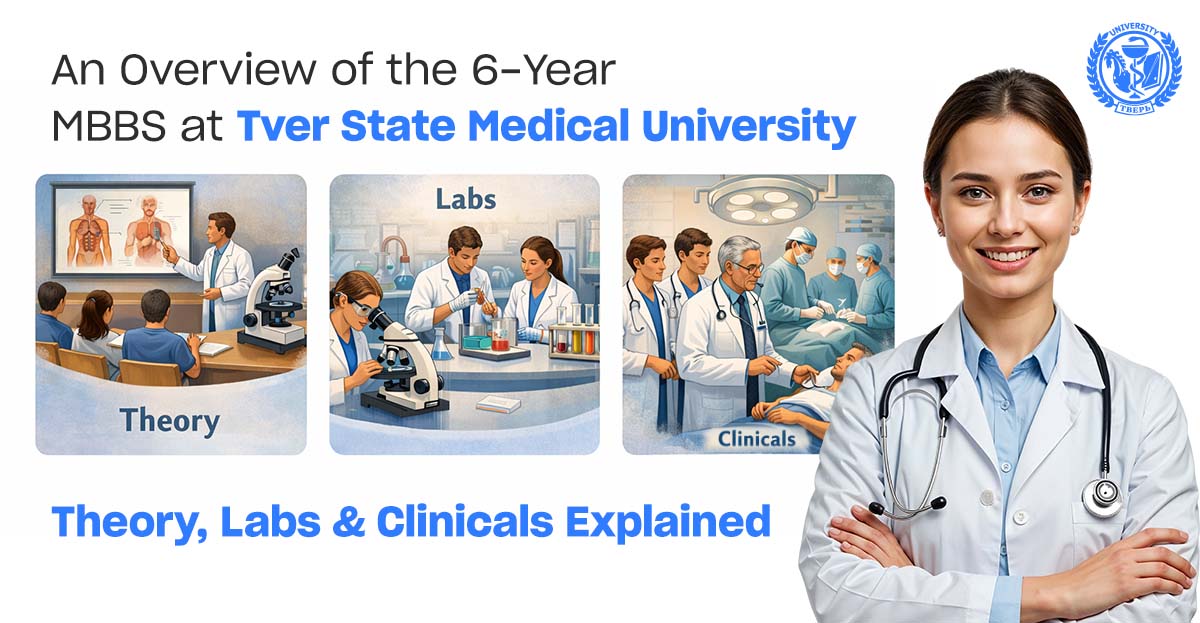
Studying MBBS in a foreign country is the ambition of every Indian student, especially due to the cost-effective study, international experience, and NMC-approved colleges. However, before making the move, it is important to learn how the 6-year MBBS course plan is comprised by foreign medical universities.
In this blog, we simplify the MBBS curriculum at Tver State Medical University into three major stages: theoretical foundations, laboratory training, and clinical rotations, so you clearly understand what you will study throughout the program.
Year-Wise Breakdown of the 6-Year MBBS Curriculum
To help students understand how the MBBS program gradually progresses from theory to real clinical practice, here is a detailed year-by-year overview followed at Tver State Medical University.
Years 1-2: Pre-Clinical - Theoretical Foundation
Focus: Basic Medical Sciences
The first two years present the main theoretical knowledge that forms the basis of medicine to the students. This stage, referred to as the pre-clinical phase, marks the beginning of the core MBBS course details that lay a strong foundation for future clinical training.
Key Subjects Include:
-
Human Anatomy
-
Physiology
-
Biochemistry
-
Histology
-
Medical Ethics
-
Latin Language/Local Language (depending on country)
In classes and labs, students are going to spend most of their time establishing the conceptual foundation necessary to continue clinical learning.
Component of the Lab:
Anatomy, dissection halls, physiology experiment practice, and biochemistry labs give students an opportunity to combine study and practical work.
Years 3-4: Para-Clinical - Introduction to Clinical Sciences
Focus: Transition from Theory to Practice
This step serves as a crucial transition between theoretical study and hospital-based learning. At this stage of the MBBS curriculum, students dive deeper into understanding disease mechanisms, diagnostics, and patient-oriented approaches.
The Key Topics:
-
Pathology
-
Microbiology
-
Pharmacology
-
Community Medicine
-
Forensic Medicine
At this point, the students are beginning to engage in clinical simulation and deliberation, and they might be coming in for entry-level hospital observation.
Lab Components:
An essential constituent of this stage is the diagnosis labs and examination of drugs, human fluids, and pathogens under the microscope.
Years 5-6: Clinical Rotations (Clerkship)
Focus: Real-Time Clinical Exposure
This is the most crucial and hands-on phase of the MBBS curriculum. Students interact directly with patients under the supervision of experienced doctors, gaining real-time experience in diagnosing and treating various medical conditions.
Important Clinical Specialities:
-
Internal Medicine
-
General Surgery
-
Obstetrics Gynaecology
-
Pediatrics
-
Psychiatry
-
Emergency Medicine
-
Orthopedics
-
Dermatology
Students spend a couple of weeks in various hospital departments and acquire clinical acumen, communication skills, and decision-making abilities.
Language of Instruction & Licensing Eligibility
The MBBS program at Tver State Medical University is taught in English for international students. However, students are required to learn the Russian language, especially for effective communication with patients during clinical training.
Graduates from Tver State Medical University are eligible to appear for international medical licensing examinations such as:
-
NEXT (India)
-
USMLE (USA)
-
PLAB (UK)
-
Other global licensing exams (subject to eligibility criteria)
Why Understanding the Curriculum at Tver State Medical University Matters
Choosing a medical university is not only about affordability but also about educational quality and clinical exposure. The structured curriculum at Tver State Medical University ensures:
-
Strong theoretical foundation
-
Extensive laboratory training
-
Comprehensive clinical exposure
-
Global career readiness
With this in Mind!
After knowing all of the points, we came to the conclusion that the MBBS program at Tver State Medical University is designed to transform students into skilled and confident medical professionals capable of working in international healthcare environments.
Before applying, students should always review:
-
Curriculum structure
-
Clinical training opportunities
-
Faculty expertise
-
NMC/WHO recognition status
If you need personalized guidance or detailed admission information, you can consult our expert counsellors for professional assistance.
FAQs
Q1. What is the syllabus of MBBS curriculum?
The MBBS river covers Anatomy, Physiology, Biochemistry, Pathology, Pharmacology, Microbiology, Forensics, Community Medicine, etc, and clinical streams such as Medicine, Surgery, Paediatrics, Obstetrics and Gynaecology, and a lot of clinical training and house jobs.
Q2. How many subjects are there in MBBS abroad?
The curriculum of the MBBS degree abroad consists of about 19-21 core units comprising pre-clinical, para-clinical, and clinical subjects with an equal distribution over the 6-year program.
Q3. Do I need to learn a foreign language during MBBS abroad?
Although the curriculum is taught in English, sometimes it is a requirement to learn the local
language in order to practice and communicate with patients.
Q4. Is an internship included in the 6-year MBBS abroad program?
Yes, there is a full-time clinical internship/clerkship usually in associated hospitals in the final year.