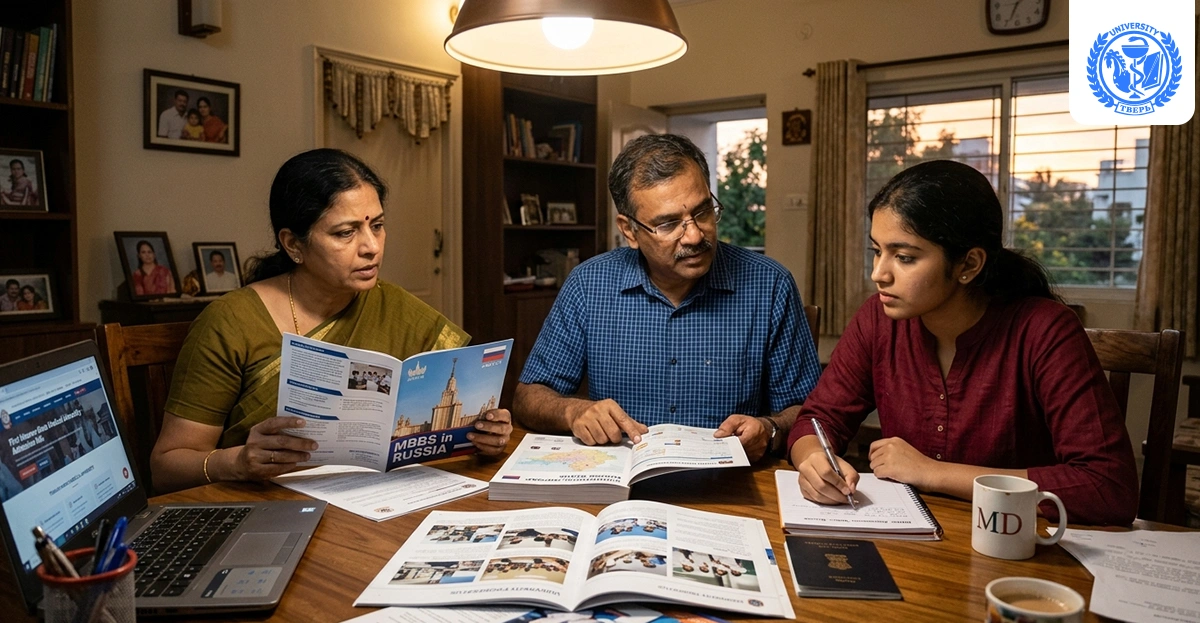
When your child expresses an interest in becoming a doctor, the next natural question that pops up is where he will be studying. Thousands of Indian families have already opted for MBBS in Russia, primarily because of the limited availability of government medical seats in India and high costs of private colleges. But before you fill out the admission forms, it's best to know a bit more about the process - eligibility criteria, cost of studies, recognition of the university, and daily life on campus. This guide is meant for those parents who prefer to have verified and precise information without promotional jargon. If you're just starting to compare options, read this overview of MBBS in Russia first.
Why Parents Consider MBBS in Russia
Russia has trained international medical students for decades, and its universities follow a six-year programme (five years of academics plus one year of clinical internship) that is broadly comparable to the Indian pattern. Parents usually shortlist Russia for a few practical reasons:
-
No donation or capitation fee: Admission is based on NEET qualification and Class 12 marks, not on a bidding system.
-
Predictable cost: Total tuition plus hostel for the full course is generally far lower than an equivalent private MBBS seat in India.
-
English-medium programmes: Many state universities run a dedicated English-medium track for international students.
-
Established infrastructure: Government-owned universities with attached teaching hospitals and long histories of international admissions.
-
Structured clinical exposure: Hospital rotations are built into the later years of the course.
The Rules Every Parent Must Check First
This is the part that decides your child's career, so treat it as non-negotiable homework.
NEET and NMC compliance
To practise in India after studying MBBS abroad, your child must qualify NEET-UG before admission and must later clear the Foreign Medical Graduate Examination. The Foreign Medical Graduate Licentiate Regulations, 2021 also require that the course be at least 54 months long, taught in one country and one institution, with a 12-month internship, and in the same language as the medium of instruction. Read the official rules directly on the National Medical Commission website instead of relying on an agent's summary.
University recognition
Check that the university appears in the World Directory of Medical Schools and is a recognised state institution. Cross-verify the name, city and programme duration on the university's own website.
Get everything in written
Ask for a written fee break-up covering tuition, hostel, medical insurance, visa invitation and registration. A genuine institution will give you this without hesitation.
What the Course Actually Looks Like
Understanding the academic path removes most of the anxiety around the decision to study MBBS in Russia.
| Stage | Duration | Focus |
| Years 1–2 | 2 years | Anatomy, physiology, biochemistry, basic Russian language |
| Years 3–4 | 2 years | Pathology, pharmacology, microbiology, early clinical subjects |
| Year 5 | 1 year | Specialised clinical departments and hospital postings |
| Year 6 | 1 year | Clinical internship in affiliated teaching hospitals |
Most Russian medical universities also teach conversational Russian in the first two years.
This is not optional fillerit is what allows your child to talk to patients during hospital rotations.
Cost, Climate and Campus Life
If you are an Indian candidate aspiring to pursue MBBS in Russia, knowing about the total expense, weather, and campus culture can assist you in being well-prepared and ready for your medical studies.
Budgeting realistically
Beyond tuition and hostel, plan for airfare, winter clothing, local travel, mobile and internet, personal expenses, and FMGE coaching in the final year. Many families underestimate the first-year setup cost, so keep a buffer.
Food and daily comfort
Indian mess facilities, vegetarian options and Indian grocery stores are available in most university cities. Ask specifically whether the hostel has an Indian kitchen and who runs it.
Weather
Winters are long and cold. Students adapt within a semester, but proper clothing bought locally makes a real difference.
Safety and supervision
Ask about hostel wardens, campus security, attendance monitoring and the process for informing parents about academic performance. Regular communication with the university's international students department matters more than any brochure.
Questions Parents Should Ask Before Paying
-
Is the university a state (government) institution?
-
Is the MBBS programme fully English-medium for the full duration?
-
What is the exact total cost for six years, year by year?
-
What is the FMGE and licensing exam support system?
-
How are hospital rotations organised, and in which hospitals?
-
What documents are required for the student visa, and who prepares them?
-
Is there an Indian student community and on-campus support staff?
Conclusion
Picking MBBS in Russia for your kid is a decision that requires time and money as well as patience, emotions, and efforts just like all other big decisions made by the family. Ensure that your kid meets the requirements of NEET, ensure that the college is compliant, read the rules and regulations of NMC yourself and ask for a proper and detailed fee structure in writing. After completing all these four aspects, things will become much easier for you. In case you want us to take you through a step-by-step process according to your kid’s marks and budget, we can do so. Talk to our admissions counselors for an obligation-free discussion regarding your kid.
FAQs
Is NEET compulsory for MBBS in Russia?
Yes. NEET-UG qualification is mandatory for Indian students who intend to practise in India later.
Will my child need to learn Russian?
Classroom teaching is in English in English-medium programmes, but basic Russian is taught and needed for patient interaction.
Can my child practise in India after graduating?
Yes, after clearing the required screening or licentiate examination and completing the internship as per NMC regulations.
Is a gap year a problem?
Policies differ by university, so confirm this in writing during admission.